7 Reasons Your LED Lights Flicker When Appliances Start
Last Updated: November 4, 2026
Quick Summary
Your led lights flicker when appliances start because the appliance's inrush current creates a brief voltage drop on the circuit, and LED drivers respond to that dip instantly. Short-lived dimming at startup is usually harmless, but persistent or widespread flicker points to wiring, driver or supply faults worth checking.
- Inrush current is the brief surge a motor or compressor draws when it first starts, well above its running draw.
- A shared circuit means lights and the appliance draw from the same supply, so the lights lose during startup.
- A single flickering fitting points to the driver or globe, while whole-circuit flicker points to supply or wiring.
- Log the appliance, time, rooms affected and flicker duration for a week to shorten the electrician's fault-finding visit.
- Call an electrician promptly for flicker with heat, buzzing, a burning smell or a breaker that trips repeatedly.
Table of Contents
- Why LED Lights Flicker When Appliances Start
- How a Flicker Becomes Visible in an LED
- Common Causes of Flickering LED Lights at Appliance Startup
- LED Driver Flickering Symptoms You Can Spot Yourself
- Loose Wiring and Flickering Lights: The Safety Signal Not to Ignore
- Diagnosing the Problem: Which Lights Flicker and for How Long
- Safe Checks to Try Before You Call Anyone
- When to Call an Electrician for Flickering Lights
- Book a Licensed Electrician to Trace the Fault
- Frequently Asked Questions
Why LED Lights Flicker When Appliances Start
If your LED lights flicker the moment the fridge or air conditioner kicks in, you are seeing a voltage dip, not a failing bulb.
This guide explains the likely causes, starting with the two that account for most cases. Below, we show you which checks you can do safely and which ones need a licensed electrician.
The good news: short-lived dimming at startup is usually harmless. Persistent flickering is a different story, and we will show you how to tell them apart.
How a Flicker Becomes Visible in an LED
An LED is far more sensitive to small voltage changes than a halogen or incandescent globe. LED lights flicker when the voltage feeding the driver dips even slightly, because the driver briefly loses its ability to hold a steady output.
Older bulbs had a hot filament that smoothed out tiny dips. An LED driver is electronic, so it responds instantly. That is why a voltage fluctuation you never noticed before suddenly becomes visible.
Two things make it worse:
- A cheap or failing LED driver that cannot cope with small supply changes
- A dimmer that is not compatible with the LED globe, which adds its own instability
If the flicker only appears on dimmed circuits, the dimmer and globe pairing is the first thing to question.
Common Causes of Flickering LED Lights at Appliance Startup
Most cases come down to a short list of causes, and you can usually narrow it down without opening anything. The table below maps each cause to the telltale sign and the fix.
| Cause | Telltale sign | Who fixes it |
|---|---|---|
| Inrush current voltage drop | Brief dim on startup only | Electrician if severe |
| Shared or overloaded circuit | Flicker across several rooms | Electrician |
| Loose wiring or connection | Random flicker, buzzing, warmth | Licensed electrician only |
| Faulty appliance | Flicker tied to one appliance | Appliance technician |
| Failing LED driver | Flicker on one fitting | Electrician or replacement |
| Dimmer incompatibility | Flicker when dimmed | Electrician |
| Supply-side issue | Flicker across the whole home | Electrician, then utility |
The first two causes explain the majority of startup flicker. We cover each in detail below.
Inrush Current and the Voltage Drop It Creates
Inrush current is the brief surge of current a motor or compressor draws when it first starts, well above what it uses while running. That surge creates a voltage drop on the wiring feeding it, and every light on that circuit sees the dip.
Large appliances are the usual suspects:
- Refrigerators and freezers, whose compressors cycle on and off
- Air conditioners, especially when the outdoor unit starts
- Washing machines and dishwashers, at the start of a cycle
The dip lasts a fraction of a second. That matches the classic symptom: a quick blink or dim exactly when the appliance starts, then normal brightness.
Shared Circuits and Overloaded Load Demand
A shared circuit means your lights and the appliance draw from the same circuit. When the appliance starts, its surge competes with the lights for the same supply, and the lights lose.
Load demand matters too. A circuit has a capacity, and if it is already close to that limit, any extra draw shows up as a voltage sag. Signs of an overloaded circuit include:
- Flicker across several rooms, not just one
- A breaker that trips when appliances run together
- Warm power points or a warm switch plate
A dedicated circuit for large appliances solves this properly. If your home's capacity is the real question, a licensed electrician can assess what the circuit can safely carry. You can also read how home electrical capacity is assessed.
LED Driver Flickering Symptoms You Can Spot Yourself
The LED driver is the small power supply inside or behind the fitting that converts mains power to what the LED needs. When it starts to fail, the flicker has a different pattern from a voltage dip.
Watch for these LED driver flickering symptoms:
- Flicker that happens constantly, not just at appliance startup
- A fitting that flickers while others on the same circuit stay steady
- Delayed turn-on, or a glow that lingers after switch-off
A single flickering fitting points to the driver or the globe. Flicker across a whole circuit points to supply or wiring. That distinction saves a lot of guesswork.
Loose Wiring and Flickering Lights: The Safety Signal Not to Ignore
Loose wiring and flickering lights are a pairing worth taking seriously. A poor connection raises resistance, which causes heat, and heat at a connection is how electrical fires start.
Treat these as warning signs:
- Flicker that is random rather than tied to an appliance
- Crackling or buzzing at a switch or power point
- A switch plate or power point that feels warm
Watch out: a loose connection at a terminal can arc quietly for months before it fails. Do not tighten terminals inside a switchboard yourself. For a deeper look, read our guide on how to assess old home wiring.
Diagnosing the Problem: Which Lights Flicker and for How Long
Diagnosis starts with two questions: which lights flicker, and for how long? The answers narrow the cause faster than any tool, and they give an electrician a head start before anyone opens a switchboard.
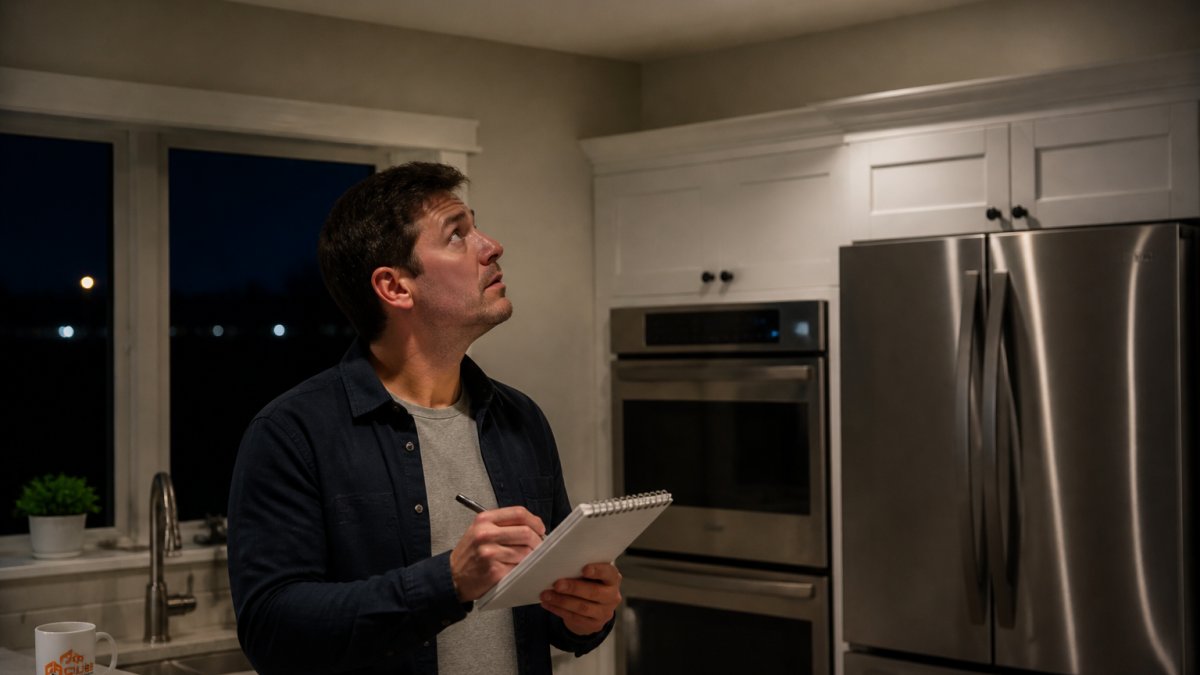
Work through this flow:
- One fitting only? Check the globe and driver first. If a known-good globe still flickers in that fitting, the driver or the fitting's connection is the likely cause.
- One room, when one appliance starts? A shared circuit is likely. The appliance and the lights are competing for the same supply.
- Several rooms, every time a large appliance starts? Voltage drop from inrush current is the leading candidate, especially if the appliance is on a long or undersized run.
- Whole home, randomly? A supply-side or main connection issue is possible. This is the pattern that most often needs the utility involved after an electrician has checked the premises.
- Only when dimmed? Dimmer compatibility is the first thing to question. A non-dimmable globe on a dimmer circuit will often flicker at low levels even when the supply is steady.
Note the duration. A blink under a second is a startup dip. Flicker that continues for minutes after startup points to the appliance, a connection, or a driver that is failing under load.
How to Document and Measure the Problem Safely
A simple log is more useful to an electrician than a vague description.
The flicker may be worse at times when more loads are running. Note that too, along with any recent changes such as a new appliance, a renovation, or a switchboard upgrade.
Watch out: do not remove switchboard covers or probe live terminals to measure voltage yourself.
If the log shows flicker across multiple circuits, or flicker that is getting more frequent, treat it as a prompt to book a licensed electrician rather than a pattern to keep watching.
Safe Checks to Try Before You Call Anyone
You can rule out several causes without touching wiring. These checks are safe for any homeowner.
- Swap the flickering globe for a known good LED of the same type
- Test a non-dimmable globe in the same fitting
- Note whether the flicker follows the globe or stays with the fitting
Keep a simple log for a week. Note the appliance, the time, which lights flickered, and how long it lasted. That record is genuinely useful to an electrician, and it shortens the fault-finding visit. If you want to escalate, contact Cube Automation to discuss an inspection. See how to book a home electrical safety inspection.
When to Call an Electrician for Flickering Lights
Call an electrician when the flicker is persistent, widespread, or comes with heat, buzzing, or a tripping breaker. Those signs point to wiring or connection faults that need testing with proper instruments, and they are not faults to keep watching.
Warning Signs That Need Prompt Attention
Stop troubleshooting and seek professional help if you notice any of the following:
- A burning smell, or any smell of hot plastic near a switch, power point, or fitting
- Crackling, buzzing, or arcing sounds at a switch, power point, or switchboard
- A switch plate, power point, or switchboard that feels warm or hot
These signs point to connection or wiring faults that can escalate. Do not tighten terminals inside a switchboard yourself, and do not ignore a warm switch plate because the flicker seems minor.
Lower-Risk Patterns Worth Booking a Check
Book promptly, but without the same urgency, if you notice:
- Flicker across multiple circuits
- Flicker that started after a renovation or a new appliance installation
- Flicker that is getting more frequent or more pronounced over weeks
Short-lived dimming at appliance startup with no other symptoms is lower risk. It still deserves a check if it is getting worse, because a small voltage dip that is becoming more visible often means a connection or capacity issue is developing.
When the Utility May Need to Be Involved
Some flicker originates outside the home.
An electrician can check the premises first and confirm whether the cause sits inside the home or on the supply side.
Licensed electricians test circuits under load and confirm what is actually happening, rather than guessing. If you are unsure which category your flicker falls into, book a check and describe the pattern you have logged.
Book a Licensed Electrician to Trace the Fault
Tracing a flicker properly means testing the circuit under load, checking connections, and confirming whether the cause sits in the wiring, the appliance, or the supply.
Our licensed electricians can help with the fault, and Cube Automation provides licensed electrical services for residential and commercial properties, including smart home systems and civil electrical infrastructure.
To discuss your situation, contact Cube Automation for current pricing or a quote.
Frequently Asked Questions
Why do my LED lights flicker when the fridge or air conditioner starts?
Large appliances such as refrigerators and air conditioners draw a brief surge of starting current, called inrush current, when their compressors kick in. That surge pulls voltage down slightly on the circuit, and LED lights flicker because their drivers react to small voltage changes far more visibly than older incandescent bulbs did. If the flicker is short-lived dimming that recovers within a second or two, it usually points to a shared circuit or a supply that is close to its capacity. Persistent flickering after the appliance has settled needs a proper inspection.
Can loose wiring make LED lights flicker when appliances start?
Yes. A loose connection at a terminal, in a bulb socket, or inside the electrical panel creates resistance that worsens under load. When an appliance starts and current rises, that poor connection causes a voltage fluctuation the LED driver registers as a flicker. Loose wiring and flickering lights are a genuine safety concern because a poor connection can arc and overheat. Do not tighten panel connections yourself. A licensed electrician should inspect and test the circuit, particularly if the flicker is accompanied by buzzing, warmth, or a burning smell.
How can I tell whether the flickering is caused by the bulb, the driver, or the wiring?
Start with the simplest test. Swap a flickering bulb into a fitting on a different circuit. If it still flickers there, the bulb or its built-in driver is the likely culprit, especially with cheap non-dimmable bulbs on a dimmer switch. If the bulb behaves on another circuit but flickers in its original fitting, the problem sits with that circuit, its connections, or the load on it. Flicker that only occurs when a large appliance starts points away from the bulb and towards voltage drop, a shared circuit, or a loose connection.
When should I call an electrician about flickering lights?
Call a licensed electrician if the flicker is persistent rather than a brief dim on appliance startup, if it affects multiple rooms or circuits, if lights pulse without any appliance running, or if you notice buzzing, a hot switch plate, scorch marks, or a breaker that trips repeatedly. These are warning signs of an electrical fault that a visual check cannot resolve. An electrician can measure voltage drop under load, test connections, and confirm whether the cause sits in the wiring, the circuit capacity, or the service connection.
Flickering LEDs are a symptom, not a diagnosis, and the cause is usually findable with a few targeted checks. If your lights flicker every time an appliance starts and the pattern is getting worse, get it tested rather than lived with. Get started with Cube Automation and have a licensed electrician trace the fault, confirm the cause, and set out the fix in plain terms.
