Get a Quote for Smart Lighting: What to Know
Table of Contents
- What to Expect When You Get a Quote for Smart Lighting
- Key Factors That Affect Your Smart Home Lighting Installation Cost
- Smart Lighting Installation Checklist: Preparing Your Request
- The Smart Lighting Consultation: What Happens Next
- Understanding the Smart Lighting Installation Process
- DIY Versus Professional Installation: Making the Right Choice
- Integrating Smart Lighting With Existing Systems
- Frequently Asked Questions
Last Updated: October 12, 2026
What to Expect When You Get a Quote for Smart Lighting
A smart lighting quote goes beyond bulbs and fixtures. It evaluates your property, electrical infrastructure, automation goals, and integration needs, determining labour, compatibility, and timeline.
It typically includes a site visit where a licensed electrician examines your wiring, counts fixtures, and discusses which automation features matter most.
Homeowners who document their setup and priorities beforehand get more accurate quotes and faster installations.
Key Factors That Affect Your Smart Home Lighting Installation Cost
A smart lighting quote is a stack of line items, not a single number. Most installers use four buckets: equipment, labour, configuration and commissioning, and call-out or travel.
How a quote is typically itemised
Ask for these separated even if the installer presents a single total:
- Equipment, smart bulbs, switches or relays, dimmer modules, hubs, sensors, and replacement fixtures. Colour-capable bulbs and dimmable switches cost most; white-only bulbs and basic on/off relays cost least.
- Labour, a fixed price per fixture or an hourly rate plus materials. Switch replacement and new wiring cost more than bulb swaps because they involve isolation, testing, and certification.
- Configuration and commissioning, app setup, scenes, voice assistant linking, schedules, and hub pairing. Often bundled into labour but sometimes quoted separately, worth clarifying.
- Call-out or travel, a fixed attendance fee for the site visit and any return trips. Ask whether it covers one visit or several.
- Consumables, cable, connectors, wall plates, brackets, and mounting hardware. Small individually, noticeable across a whole-home job.
- Exclusions, plaster repair, painting, ceiling access, asbestos handling, and switchboard upgrades are commonly excluded. An exclusion is fine if written down; a problem if it appears as a variation later.
What actually moves the number
Number and type of fixtures. Quantity is the primary driver, five smart bulbs is a different job from a three-storey home.
Existing wiring and infrastructure. Modern wiring with an accessible switchboard and spare circuit capacity keeps labour contained.
Access and building type. Double-storey voids, raked, tiled or heritage ceilings, and solid masonry walls slow the work.
Automation complexity. Basic on/off and scheduling is cheap to configure.
Indicative quote shapes
Exact figures vary, but the shape of a quote is consistent. A small project, a handful of smart bulbs, no wiring changes, is dominated by equipment cost. A mid-range project, a room or two of smart switches plus a hub, app setup, and voice control, splits roughly between equipment and labour.
Compare the composition, not just the total, a cheaper quote may simply exclude configuration, testing, or the return visit.
A note on ongoing costs
Upfront price is only part of ownership. Factor in hub or bridge hardware, subscription fees, replacement bulbs, and electricity use, smart bulbs draw a small standby load even when off, and always-on hubs add a continuous trickle. Small individually, but they belong in your total cost of ownership.
Comparing quotes and verifying scope
Before accepting any quote, check it states in writing: exact devices and quantities, whether configuration and app setup are included, whether testing and certification are included, warranty terms for labour and equipment separately, what is excluded, and post-installation support. A quote answering all six can be compared fairly.
Smart Lighting Installation Checklist: Preparing Your Request
Most quote requests fail because the installer can't see the property, so they either pad the estimate or quote a best-case number that grows on arrival. Hand over enough detail that the quote is built on facts. Work through this checklist first.
What to send with your quote request
Property details
- Type and construction, single-storey, double-storey, townhouse, apartment, or rental.
- Approximate age, or age of the most recent electrical work.
- Whether you own it or need landlord approval.
Room-by-room fixture inventory
- A count of every light point to upgrade, grouped by room.
- Fixture type, downlight, pendant, wall sconce, batten, or outdoor fitting.
- Whether you're keeping the fixture and changing only the bulb or switch, or replacing the fixture.
Photographs
- One per fixture type, light on and fitting visible.
- Each switch plate, front and, if safe, the wiring behind it.
- The switchboard showing main switch, circuit breakers, and spare ways.
- Any existing smart home hardware, hubs, or bridges.
Wiring and switch information
- Whether switches have a neutral wire. If unsure, say so, the installer will check, but flagging it saves a surprise.
- Whether any circuits are at capacity or have tripped repeatedly.
- Whether ceiling space above the rooms is accessible.
Controls and automation preferences
- How you'll control the lights: wall switch, app, voice assistant, motion sensor, or a combination.
- Which rooms need dimming, colour, or only on/off.
- Scheduling or scene requirements, outdoor lights at sunset, hallway lights on motion after dark.
Existing ecosystem and future plans
- Which smart speaker, hub, or platform you already use.
- Devices you plan to add later, climate control, cameras, blinds, sensors, so the installer designs for expansion rather than retrofitting it.
Practical constraints
- Access restrictions, parking, building management or strata rules.
- Preferred timing and whether the property will be occupied during the work.
Compatibility and future-proofing check
Run this quick check before requesting a quote so you can brief the installer accurately:
- Switches, standard toggle or rocker, and whether a neutral is present. This determines which smart switch families are viable.
- Wiring, whether lighting circuits are earthed and the switchboard has spare capacity.
- Wi-Fi, check coverage in the rooms you want to automate. Weak signal causes dropouts that look like faulty hardware; a mesh node or hub-based protocol often solves it.
- Hubs and protocols, whether existing devices use Wi-Fi, Bluetooth, Zigbee, Thread, or a proprietary bridge. Smart lighting must speak the same language, or you'll juggle multiple apps.
- Voice assistants, which assistant you use and whether the lighting brand supports it natively.
- Interoperability, whether proposed devices work with a standard automation platform or only the manufacturer's app. Platform-locked devices are harder to expand later.
Identify your automation priorities
Be specific about what the system should do, not just which rooms it covers. App control, voice control, sunset scheduling, motion-triggered security lighting, and colour scenes are distinct requirements with different hardware and configuration implications. A colour-and-voice system costs more than basic on/off automation, and telling the installer which you need prevents over- or under-specification.
DIY versus professional: where the line sits
Some of this work is DIY-friendly, some is not. Replacing bulbs with smart equivalents in existing fittings needs no electrical work, and a plug-in smart switch or smart plug is similarly low-risk. The moment the job involves fixed wiring, replacing a wall switch, installing a new fixture, adding a circuit, or outdoor wiring, it falls to a licensed electrician.
Use the checklist above to decide which side of that line your project sits on, then request quotes only for the portion requiring a licensed trade.
The Smart Lighting Consultation: What Happens Next
Your consultation is where the installer moves from general quote to specific plan. A licensed electrician visits, assesses your setup, and discusses your priorities.
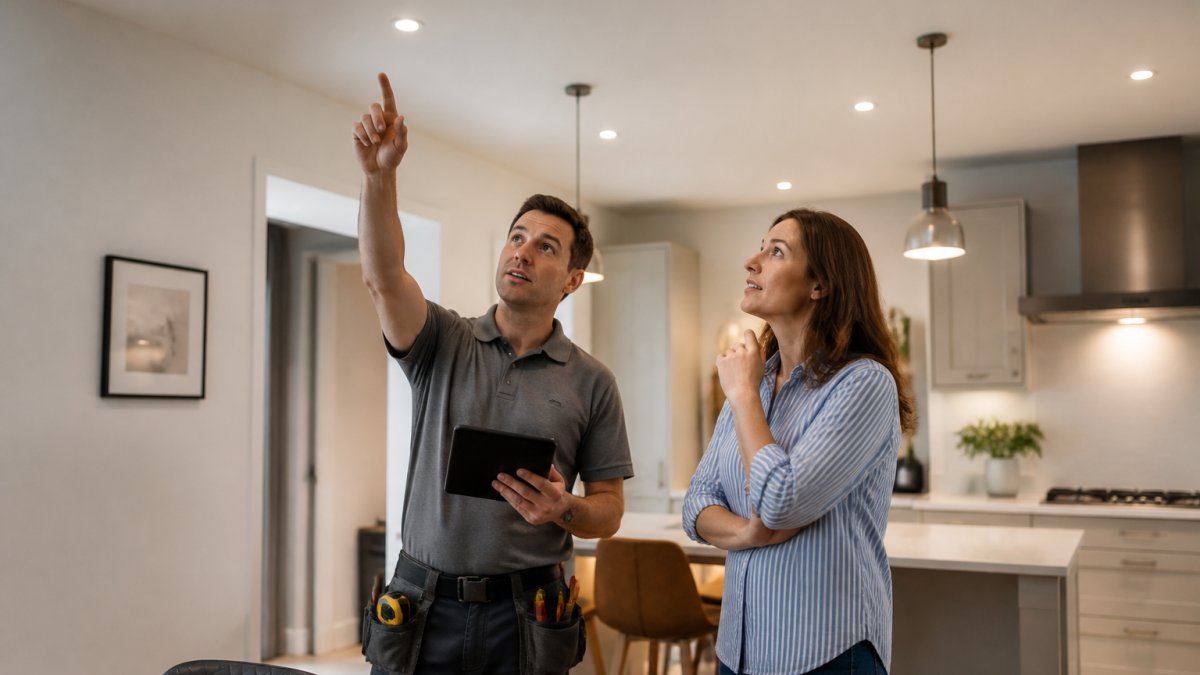
The installer examines your electrical infrastructure, identifies fixture locations, and discusses which automation features suit you.
This conversation generates the detailed quote: labour time, material requirements, and any complications. They'll explain what's included, old fixture disposal, post-installation testing, and app or voice control training.
Understanding the Smart Lighting Installation Process
Installation follows a logical sequence. Understanding the process helps you prepare your home and set realistic expectations for timeline and disruption.
Design and planning phase
Before installation begins, the installer finalises the design: which fixtures are replaced, where smart switches go, and how the system integrates with your existing setup. They order materials and schedule the date. Any electrical upgrades, additional circuits, rewiring, or switchboard modifications happen first.
This phase depends on material availability and whether upgrades are needed. The installer also confirms compatibility with any existing smart home devices.
Installation and testing
Installation involves replacing fixtures, fitting smart switches, running new wiring, and configuring the system. The installer tests each component and confirms all automation features work as designed.
They'll also set up your mobile app, configure voice control if you use a smart speaker, test scheduling, and walk you through basic troubleshooting.
Handover and support
At handover, the installer provides documentation, a device list, app access instructions, and support contact details. Reputable installers offer follow-up support in the first few weeks.
Ask about ongoing support before committing. What happens if a device stops responding months later, remote troubleshooting, or a paid return visit? Clarifying this prevents frustration later.
DIY Versus Professional Installation: Making the Right Choice
Smart lighting projects range from simple to complex, some homeowners install smart bulbs themselves, others need professional help.
DIY works best for straightforward projects: replacing bulbs with smart alternatives in existing fixtures, or adding a single smart switch.
Professional installation is necessary for rewiring, new fixtures, multi-system integration, or older electrical infrastructure.
The cost difference is significant.
Consider professional installation for older wiring, complex automation, outdoor lighting, or existing smart home devices you want to integrate, these benefit from expertise that prevents costly mistakes.
Integrating Smart Lighting With Existing Systems
If you already have smart home devices, your new smart lighting must communicate with them, the point where many DIY projects fail and professional installers add real value.
Smart home hubs communicate with lights through Wi-Fi, Bluetooth, or proprietary protocols.
Some systems work independently through their own app; others integrate into broader platforms. If you plan to add climate control, cameras, or other automation later, your smart lighting should be part of the same ecosystem, an installer designs with future expansion in mind.
We ensure your smart lighting integrates with what you already have and plan to add.
Getting a smart lighting quote is straightforward once you understand what installers need to assess. Document your current setup, identify your automation priorities, and be clear about compatibility requirements.
Frequently Asked Questions
What information should I provide when requesting a smart lighting quote?
Provide details about your property type (residential or commercial), the number of rooms and fixtures you want to control, your existing wiring condition, whether you need indoor or outdoor lighting, and any devices you already own that need to integrate with the new system. Include photos of your current setup and a list of automation features you want (voice control, scheduling, colour-changing bulbs, dimming). This helps your installer understand the full scope and give you an accurate quote.
How much does smart lighting installation cost?
Smart lighting installation cost depends on several factors: the number of fixtures, your property's existing electrical infrastructure, whether you need new wiring, and the complexity of your automation requirements. Indoor installations typically cost less than outdoor systems. The best way to understand pricing is to request a quote from a licensed electrician who can assess your specific situation and provide an itemised breakdown of labour, materials, and any upgrades needed to your existing wiring.
Can smart lighting be added to an existing home?
Yes, smart lighting can be added to most existing homes. However, the installation process and cost depend on your current wiring condition. Homes with modern electrical infrastructure may need minimal work, whilst older properties with outdated wiring may require upgrades before smart systems can be safely installed. A professional consultation will identify whether your existing fixtures and wiring are compatible with smart bulbs and switches, or if rewiring is necessary.
What should a smart lighting quote include?
A comprehensive quote should itemise labour costs, the price of smart bulbs and fixtures, any required electrical upgrades or rewiring, smart home hub or controller costs, installation timeline, and warranty information. It should also specify which devices will be compatible with your system and outline any ongoing maintenance or support included. Ask your installer to clarify what happens if devices fail after installation and whether they offer post-installation support.