
How Do You Assess Home Electrical Capacity?
Last Updated: November 2, 2026
Quick Summary
Assess home electrical capacity by reading the main breaker and switchboard ratings, then adding up the load your appliances can draw. The spare capacity left after that calculation shows what new equipment your supply can safely handle. Confirm the result with a licensed electrician before relying on it.
- Check the main breaker amp rating and the switchboard label, and photograph both.
- The lowest of the service rating and panel rating sets your real limit.
- Convert appliance watts to amps by dividing by the 230 V supply voltage.
- Apply demand factors, since not every appliance runs at full power at once.
- Only a licensed electrician should open the switchboard or confirm capacity.
Table of Contents
- Service rating, panel rating and spare capacity
- How to Read Your Switchboard Rating and Main Breaker
- Calculating Your Home Electrical Load Step by Step
- Signs of an Overloaded Electrical System to Watch For
- Assessing Capacity for a Renovation or New Build
- Adding Circuits to an Existing Switchboard Safely
- Booking a Capacity Assessment With Cube Automation
- Frequently Asked Questions
Knowing how to assess home electrical capacity tells you whether your switchboard can safely handle what you plan to run. Before you add a heat pump, an EV charger or a smart home system, check that the existing supply has room to spare. This guide walks through the process in plain steps, from reading your switchboard to calculating your load.
Electrical capacity is the maximum power your home's supply can deliver safely at one time. It is measured in amps at the main breaker and in kilowatts (kW) for the total power available. Capacity is the ceiling. Load is what you are actually drawing from it.
Many homeowners assume a bigger number on the switchboard means more usable power. That is not always true. The label tells you the size of the panel, but what matters is how much of that capacity is still free.
Service rating, panel rating and spare capacity
These three terms are often mixed up, so it helps to separate them:
- Service rating: the maximum current the utility supply to your home can deliver, usually set by the incoming main fuse or supply cable.
- Panel rating: the maximum current the switchboard itself is built to carry, shown on its label.
- Spare capacity: the portion of the service that is not yet in use.
The lowest of the service and panel ratings sets your real limit. Spare capacity is what you have left after your existing appliances are accounted for.
How to Read Your Switchboard Rating and Main Breaker
Start by finding the main switch or main breaker, usually the largest switch at the top or side of the board. Its amp rating is printed on the switch or the handle. A 63 A main, for example, means the home is supplied at up to 63 amps.
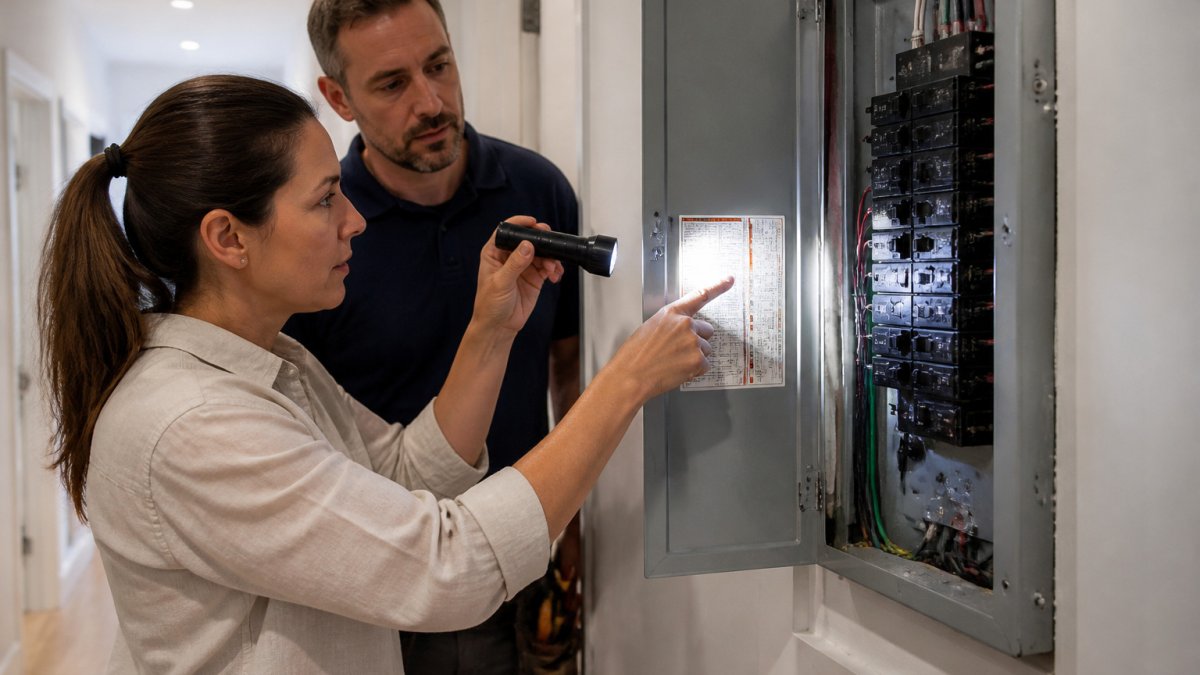
Next, look for the switchboard label. It usually lists the rated current and sometimes the supply voltage. Note both numbers.
Some practical checks:
- Photograph the labels before you call anyone. It saves time.
- Look for a supply-authority sticker, which can show the incoming service size.
- Check any previous electrical certificates or switchboard upgrade records.
- If the label is missing or unreadable, do not guess. Get a licensed electrician to confirm it.
Opening the switchboard cover is not a homeowner task. Only a licensed electrician should open the board.
Calculating Your Home Electrical Load Step by Step
Load calculation adds up the power your appliances and devices can draw, then applies adjustments to reflect realistic simultaneous use. The arithmetic is simple, but the assumptions matter more than the sums. A transparent worked example is the best way to see where estimates go wrong.
- List every fixed appliance, such as the oven, cooktop, hot water system, air conditioner and pool pump.
- List the portable appliances you use regularly, such as the kettle, washing machine and dryer.
- Note the wattage of each item from its nameplate or manual.
- Convert everything to amps at the nominal 230 V supply.
- Apply demand factors to reflect realistic simultaneous use.
- Compare the adjusted total with your service rating and your existing load to find spare capacity.
Appliance and device wattage
Every appliance has a wattage (W) or kilowatt rating (kW) on its label. A typical kettle might be 2,200 W, and a split-system air conditioner might be 2,500 W or more. If only amps are listed, multiply amps by the supply voltage to get watts. At the nominal 230 V supply, a 10 A device draws about 2,300 W.
Keep a simple table as you go:
| Appliance | Rated power (W) | Amps at 230 V | Typical use |
|---|---|---|---|
| Electric oven | 2,400 | ~10.4 | Daily |
| Kettle | 2,200 | ~9.6 | Several times a day |
| Hot water system | 3,600 | ~15.7 | Continuous, controlled |
| Split-system air conditioner | 2,500 | ~10.9 | Seasonal |
| EV charger (7 kW) | 7,000 | ~30.4 | Overnight |
Nameplate ratings are often the maximum. Real use is usually lower, but use the nameplate figure for a safe estimate. Do not add up every nameplate and assume that is your load, that overstates demand and can push you toward an unnecessary upgrade.
Converting watts to amps and applying demand factors
To convert watts to amps, divide watts by the supply voltage. A 4,600 W load on a 230 V supply draws about 20 A.
Not every appliance runs at full power at once. Many electricians apply a demand factor, which reduces the combined load to reflect realistic use. Professional load calculations, including those used under AS/NZS 3000 (the Australian wiring rules), apply demand factors for different categories of load. Treat any homeowner estimate that uses a demand factor as rough, and confirm the figure with a licensed electrician before relying on it.
Worked example: adding a 7 kW EV charger
Suppose a home has a 63 A single-phase service. The existing fixed load is estimated at 28 A after demand factors, leaving roughly 35 A of spare capacity on paper. A 7 kW EV charger draws about 30.4 A at 230 V. On those numbers the charger fits, but only just, and only if the existing load estimate is accurate and the charger is on a dedicated circuit with its own breaker.
A second example: a home with a 40 A service and an existing adjusted load of 32 A has only about 8 A spare. A 7 kW charger (30.4 A) clearly does not fit without a service upgrade. A smaller 3.6 kW charger (about 15.7 A) still exceeds the spare capacity, so the honest answer is that the service needs upgrading before any EV charging is added.
These examples show why the headline number on the switchboard is not the answer. The answer is spare capacity after demand factors, and that figure needs a licensed electrician to confirm.
Why energy use is not the same as electrical load
A quarterly bill in kilowatt-hours tells you how much energy you used over time. It does not tell you the peak load the supply must carry at any one moment. A home can have modest monthly consumption and still have a peak load that strains the service when the oven, air conditioner and charger run together. Use kWh figures to understand running costs, not to judge whether the panel can support a new appliance.
Signs of an Overloaded Electrical System to Watch For
An overloaded system often gives warning signs before anything fails. Watch for:
- Breakers that trip when several appliances run together
- Lights that dim or flicker when a large appliance starts
- Switches, outlets or the switchboard that feel warm or smell of burning
- Discoloured or cracked outlet covers
- A hum or buzzing from the switchboard
Any of these signs calls for a licensed electrician. Do not reset a breaker repeatedly without finding the cause.
Assessing Capacity for a Renovation or New Build
Renovations and new builds change your load, so the assessment needs to cover the future as well as the present. List any planned additions, such as a kitchen upgrade, a pool, an EV charger, a battery system or a smart home network. Add them to your existing load estimate.
Older homes need extra attention. Wiring, switchboards and supply cables installed decades ago may not suit modern loads. Plan for capacity checks early, before walls are closed up. Good planning avoids a costly rewire later.
Adding Circuits to an Existing Switchboard Safely
Adding a circuit means new wiring, a new breaker and a space on the board. Two things must be checked first: whether the board has room, and whether the spare capacity can carry the new load.
If your switchboard is worn, full or underrated, an upgrade is usually the safer route. A licensed electrician can advise on the options and carry out the work to current Australian standards. Never add a circuit by modifying the board yourself.
Booking a Capacity Assessment With Cube Automation
If you are unsure what your home can handle, a licensed assessment removes the guesswork. A licensed electrician can check the service and panel ratings, measure the existing load and tell you what spare capacity you have for new work.
To arrange an assessment, contact Cube Automation for current details and a quote. Renovating or building new? Our guide to renovating old wiring for automation covers the same ground in more detail, and the full home renovation electrical guide explains how to plan electrical work across a whole project. If your switchboard looks worn or near its limit, upgrade your electrical infrastructure to see what a switchboard upgrade involves. For a closer look at older wiring, assessing old home wiring explains what to check for hazards.
For official guidance on residential electrical safety, see Energy Safe Victoria electrical safety guidance and Standards Australia AS/NZS 3000 wiring rules.
Frequently Asked Questions
How do I check my home's electrical capacity?
Start by finding the main switch or main breaker in your switchboard, which is usually labelled with an amperage rating such as 63A or 80A. This rating shows the maximum current your switchboard can supply. Next, check your electricity bill or the supply details from your retailer or network operator for the service rating. Compare these figures with a rough load estimate from your appliances. If the labels are missing or unclear, a licensed electrician can confirm the rating and calculate usable spare capacity safely.
Do I need an electrician to assess my home's electrical capacity?
You can read the switchboard label and make a basic wattage estimate yourself, but opening the switchboard or testing live components is work for a licensed electrician. Only a licensed professional should inspect or modify the switchboard. A professional assessment includes checking the service rating, the condition of the wiring, the number of spare ways in the board and whether the existing circuits can carry new loads. This is especially important before a renovation or adding solar and battery systems.
When should I upgrade my switchboard or electrical supply?
Consider an upgrade if your switchboard has no spare ways for new circuits, if breakers trip regularly when several appliances run together, or if you are adding large loads such as an EV charger, heat pump or new kitchen. An electrician can compare your calculated maximum demand with the existing service rating. Where the calculated load exceeds what the supply can safely deliver, a service or switchboard upgrade is usually the safer and more cost-effective option than working around the limit.
How can I tell if my switchboard is overloaded?
Common signs include breakers that trip repeatedly, lights that dim when large appliances start, warm or discoloured switchboard components, a burning smell near outlets, and buzzing from the board. Any of these signs warrants prompt attention. Turn off the affected circuit if it is safe to do so, avoid resetting a breaker that keeps tripping, and arrange for a licensed electrician to inspect the switchboard and wiring.
Call us to arrange a licensed capacity assessment for your home and get a clear answer on what your switchboard can support.
